Director Jing Liping’s Team: Anemia ≠ Iron Deficiency! How to Recognize and Manage Childhood Anemia

What is anemia? Why does it occur at different ages, and how should it be managed? Which easy-to-overlook warning signs should parents watch for in daily life? What is the connection between anemia and leukemia treatment? In this episode, Director Jing Liping and Director Yang Wenrui from the Anemia Diagnosis and Treatment Center of Beijing Boren Hospital present an educational guide to help families understand anemia scientifically and avoid unnecessary detours.
I. What Is Anemia, and How Is It Diagnosed?
Anemia means that hemoglobin (Hb), hematocrit, or red blood cell count in circulating blood falls below the normal range for the child’s age, sex, and altitude. Hemoglobin is the body’s main oxygen carrier, delivering oxygen to every organ. When hemoglobin is insufficient, body tissues suffer from “oxygen starvation,” producing symptoms such as pale complexion, pale lips, poor concentration, and easy fatigue.
Anemia standards. Diagnostic criteria for childhood anemia differ from those for adults and vary by age group; clinically, hemoglobin (Hb) concentration is commonly used. The 2024 WHO childhood anemia thresholds are:
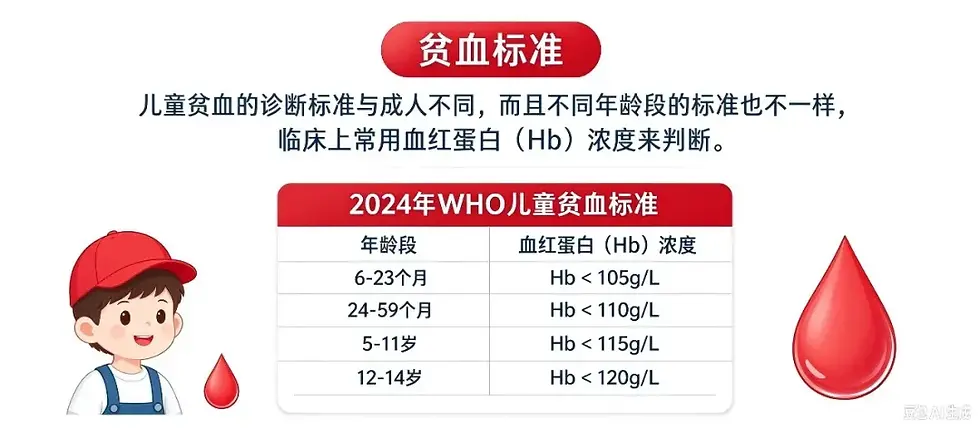
Age group | Hemoglobin (Hb) |
6–23 months | Hb < 105 g/L |
24–59 months | Hb < 110 g/L |
5–11 years | Hb < 115 g/L |
12–14 years | Hb < 120 g/L |
When identifying the cause of anemia, the absolute reticulocyte count is a key indicator of whether bone-marrow hematopoiesis remains active.
II. Anemia in the Neonatal Period (within 28 days of birth)
There are four common categories: physiologic anemia; hemorrhagic anemia (intrapartum bleeding, fetomaternal transfusion syndrome, twin-to-twin transfusion syndrome); hemolytic anemia (ABO/Rh blood-group incompatibility, G6PD deficiency, hereditary spherocytosis, etc.); and reduced production (prematurity, congenital aplastic anemia).
Physiologic anemia is the most common form in newborns. In term infants, hemoglobin drops to a low point at 6–12 weeks but does not fall below 90 g/L; no special treatment is needed, only regular follow-up. Warning signs parents should observe include: pale complexion, lethargy, weak feeding, and prolonged or worsened jaundice.
Management principles: Monitor physiologic anemia regularly; for hemorrhagic anemia, address the underlying bleeding source and transfuse when necessary; severe hemolysis may require phototherapy or exchange transfusion; children with G6PD deficiency must strictly avoid triggers such as fava beans and mothballs.
III. Anemia in Young Children (1 month – 3 years)
The most common type at this stage is nutritional iron-deficiency anemia, caused by inadequate iron intake (delayed or inappropriate complementary feeding), impaired absorption, chronic blood loss, or parasitic infection. Long-term iron deficiency not only impairs growth and development but may also affect brain development and immunity — and these effects can be irreversible.
Typical symptoms include sallow or pale complexion, poor appetite, irritability and restlessness, poor concentration, and growth retardation.
Management:
Iron-deficiency anemia: Oral iron supplements (e.g., ferrous sulfate, ferrous fumarate); generally continue supplementation for 4–6 weeks after hemoglobin returns to normal to replenish iron stores; simultaneously adjust complementary feeding with red meat puree, liver puree, egg yolk, and iron-fortified rice cereal.
Megaloblastic anemia: Supplement folic acid and/or vitamin B12 and adjust feeding structure.
Diet: Introduce iron-rich complementary foods at 4–6 months; animal iron (heme iron) has a much higher absorption rate than plant iron; pair with vitamin C-rich fruits (oranges, kiwifruit) to promote absorption.
Remove the cause: For example, switch a cow’s-milk-protein-allergic child to hydrolyzed-protein formula; control chronic infections.
A rule parents must remember: do not supplement iron on your own! Anemia in young children must be differentiated from thalassemia (prevalent in southern China, e.g., Guangdong, Guangxi, and Hainan) and from congenital hemolytic or hematopoietic defects (e.g., congenital dyserythropoietic anemia, congenital pure red-cell aplasia). Iron supplementation works only for iron-deficiency anemia; for other types it is ineffective and may even cause iron overload.
Workup for young children: complete blood count → iron metabolism (ferritin is the most sensitive marker) → reticulocyte count → peripheral blood smear → folate and vitamin B12 → stool occult blood/ova → thalassemia electrophoresis/genetic testing → bone-marrow aspiration when indicated.
IV. Anemia in Preschool and School-Age Children (3–12 years)
Iron-deficiency anemia remains the leading cause at this age, mainly related to picky eating, rapid growth, and — for girls after menarche — menstrual iron loss. Second, be alert to anemia of chronic disease (reduced erythropoietin due to chronic infection, inflammation, kidney disease, etc.), autoimmune hemolytic anemia, and aplastic anemia.
When children at this age report dizziness, memory decline, or fluctuating school performance, parents and teachers often dismiss it as “weak constitution” or “tiredness,” when in fact anemia deprives the brain of oxygen.
If anemia occurs together with skin petechiae, enlarged lymph nodes, or unexplained fever, be alert to a hematologic malignancy. Do not refuse bone-marrow aspiration simply because “the child is still young” — marrow aspiration is the gold standard for diagnosing many blood diseases, and delayed diagnosis costs far more than the procedure itself.
Management principles:
Iron-deficiency anemia: Oral iron therapy; correct picky eating; increase red meat, animal blood, and liver intake.
Anemia of chronic disease: Treat the underlying illness first; blindly supplementing iron during inflammatory states causes iron overload and harms the body.
Hemolytic anemia: Treat by cause; inherited hemolytic disorders require long-term management and trigger avoidance.
Aplastic anemia: Specialized hematology treatment, including immunosuppressive therapy or hematopoietic stem-cell transplantation; never delay.
Parasitic infection: Antiparasitic treatment.
V. Anemia in Adolescents (13–18 years)
Causes show a clear sex difference at this stage.
Girls: Menstrual blood loss (roughly 15–30 mg of iron lost per period), dietary restriction for weight loss causing inadequate nutrition, and iron demand from rapid growth are common causes of iron deficiency.
Boys: Intensive endurance exercise may cause exercise-related hemolysis, such as march hemoglobinuria, which — when severe or recurrent — can also lead to anemia.
In addition, a second peak of aplastic anemia appears around age 16; less common conditions such as autoimmune hemolytic anemia, paroxysmal nocturnal hemoglobinuria (PNH, more common in young men), and Gaucher disease also tend to present during this period.
“Enlarged spleen is never trivial.” If a child has anemia together with splenomegaly, the cause must be investigated; familial splenomegaly often points to hemolytic disorders such as hereditary spherocytosis.
The workup should be broader: erythropoietin level (which should rise several-fold as a feedback response; an inadequate rise suggests impaired renal compensation), gynecologic examination for girls, gastroscopy/colonoscopy, and lymph-node biopsy when indicated.
VI. General Principles and Myth-Busting
Anemia ≠ iron deficiency — this is the single most important point. Do not blindly supplement iron before the cause of anemia is identified. Long-term excessive iron supplementation causes iron overload, damaging the liver, heart, and endocrine function.
Correct way to take iron supplements: Take between meals for better absorption; pair with vitamin C (e.g., orange juice) to enhance absorption; avoid taking with milk, tea, or coffee. Dark stools after iron supplementation are normal — no need to worry.
Course of iron supplementation: After hemoglobin returns to normal, continue iron for at least 3 months to replenish iron stores; the stopping point should be based on ferritin returning to normal, not hemoglobin.
Prevention is better than cure. Strengthen iron intake from the complementary-feeding stage and have the child checked regularly. Seek specialist care immediately for the following danger signs: fever with anemia, bone pain, enlarged lymph nodes, or progressive worsening of anemia within a short period.
Anemia is easy to overlook but cannot be ignored. It may simply be a nutritional issue, or it may be an early warning sign of a serious disease. The key lies in — scientific understanding, standardized testing, precise diagnosis, and rational treatment.


Comments