Proton Therapy: Precision Targeting of Tumors Without Harming Healthy Tissues!

What Makes Proton Therapy Special?
If conventional photon radiotherapy (X‑rays) is like a “bomb” that releases energy continuously along its path through the body, damaging healthy tissue in front of and behind the tumor, then proton therapy is more like a precisely guided “smart missile.”
Its uniqueness stems from a distinctive physical property: the Bragg peak.
Low entrance dose: After entering the body, the proton beam releases very little energy, causing almost no damage to skin, muscles, and other healthy tissues along the path.
Targeted burst at the end: When the proton beam reaches the tumor precisely, energy is released instantaneously, focusing on cancer cells.
Rapid drop‑off beyond the target: After passing through the tumor, energy quickly falls to zero, leaving healthy tissue behind nearly unirradiated.
Simply put: It targets only the tumor and spares healthy tissue!
According to statistics from the Particle Therapy Co‑Operative Group (PTCOG), by 2021, more than 260,000 patients worldwide had received proton or heavy‑ion therapy. The number of proton centers grew from 1 in 1990 to over 100 today, and is still rising rapidly. Proton therapy has become a major global trend in precision cancer radiotherapy.
Pencil Beam Scanning: Making Treatment Even More Precise
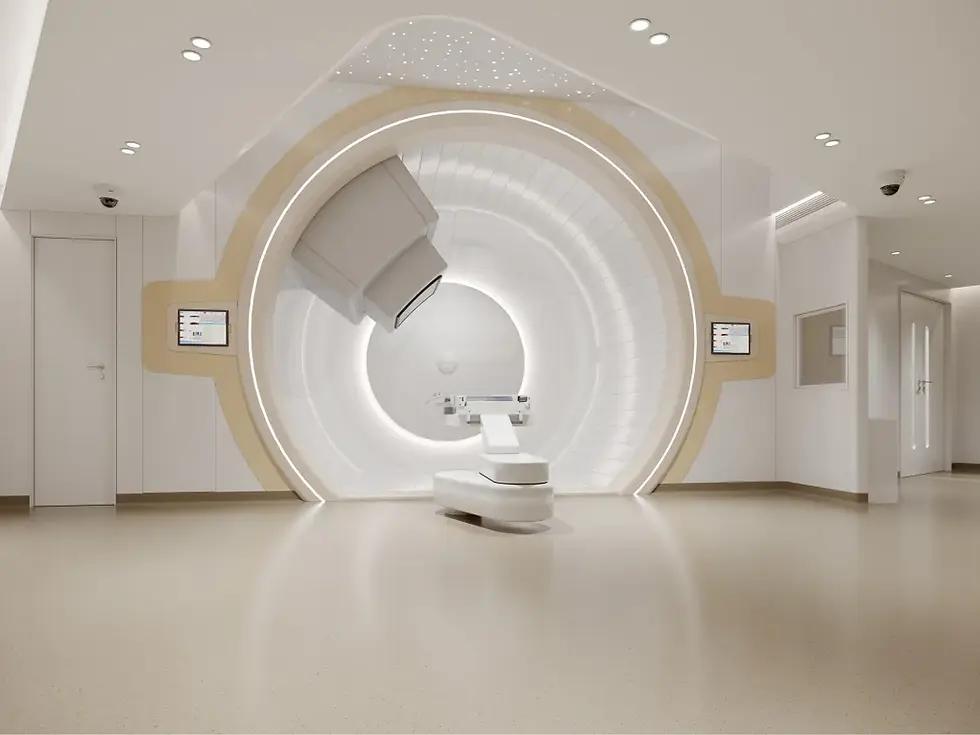
Unlike the passive scattering technology used in early proton centers, the core of modern proton therapy is pencil beam scanning (PBS). Its advantages include:
Conforms to tumor shape: The proton beam acts like an ultra‑fine pen. Under magnetic control, it scans the tumor point‑by‑point at millisecond speed, depositing dose precisely onto every 3D voxel.
No patient‑specific hardware: This technique does not require custom accessories such as lead blocks for each patient. It is fully digital and highly efficient.
Intensity Modulated Proton Therapy (IMPT): The radiation intensity at each scanning point can be adjusted in real time. Compared with conventional intensity modulated radiation therapy (IMRT), IMPT significantly reduces the low‑dose volume in healthy tissue, lowering the risk of secondary cancers and long‑term complications.

How Does It Achieve “Aim and Hit”?
The precision of proton therapy relies not only on physics but also on rigorous quality assurance and tolerance control systems.
Clinically, we typically require that ≥95% of the target volume meets a 3 mm/3% tolerance, meaning dose errors are controlled within 3 millimeters and 3%.
At the equipment level, all parameters of the proton therapy system meet strict tolerance requirements to ensure accurate and safe delivery in every session.
In addition, modern proton therapy uses robust optimization and robust evaluation to account for patient setup errors, range uncertainty, tumor shrinkage, weight loss, and other factors, ensuring reliable dose distribution during actual treatment.
Five Major Clinical Advantages: Gentler Cancer Care
1. Precision targeting, protection of critical organs
For head‑and‑neck, thoracic, abdominal, and pelvic tumors, it avoids critical organs such as the optic nerve, lens, spinal cord, heart, and lungs, reducing damage to vision, cardiopulmonary function, and more.
2. A boon for pediatric tumors
Children are in a stage of growth and development, and their tissues are highly sensitive to radiation. Proton therapy greatly reduces unnecessary radiation, significantly lowering long‑term impacts on bone growth, endocrine function, and intellectual development.
3. Breaks conventional dose limits
By sparing healthy tissue, the radiation dose can be appropriately increased, greatly improving the local tumor control rate and even offering curative chances for some advanced patients.
4. Suitable for re‑irradiation
For patients with locally recurrent tumors who have received conventional radiotherapy before, proton therapy offers new hope for this challenging re‑treatment scenario thanks to its unique dose advantages.
5. Wide indications, covering the whole body
Proton therapy is widely applicable to most solid tumors, including brain tumors, nasopharyngeal carcinoma, lung cancer, liver cancer, pancreatic cancer, prostate cancer, breast cancer, esophageal cancer, and bone and soft‑tissue sarcomas. It is especially advantageous for complex‑shaped tumors adjacent to critical organs.

Zhejiang’s First Proton Therapy Center Under Construction
On January 26, 2026, Zhejiang’s first proton therapy center officially broke ground at the Qiantang Campus of Sir Run Run Shaw Hospital, Zhejiang University School of Medicine.
The center will be equipped with an internationally advanced 360° gantry proton therapy system, plus cutting‑edge auxiliary diagnostic and treatment equipment including linear accelerators, CT, MR, and PET. It will provide patients with full‑process, convenient, precise “one‑stop” diagnosis and treatment services centered on proton therapy.
With the completion of Zhejiang’s first proton therapy center, more patients will be able to receive world‑class precision radiotherapy close to home.
From conventional radiotherapy to millimeter‑level precision targeting, Sir Run Run Shaw Hospital, Zhejiang University School of Medicine, always upholds the philosophy “Sincerity, Confidence and Love for You,” standing at the global forefront of cancer treatment technology to build a solid line of defense for patients’ lives.


Comments