Sun Xiaoxi and Zhang Feng’s Collaborative Study Identifies ACTL7A as a Male Pathogenic Gene Causing Early Embryonic Arrest, Elucidates Its Mechanism and Explores Intervention Strategies

Obtaining viable and transferable embryos is the key to the success of in vitro fertilization (IVF). However, in clinical practice, some couples exhibit repeated early embryonic arrest despite having seemingly "normal" sperm and oocytes. Clinicians generally attribute this issue to female rather than male factors, especially when sperm is diagnosed as normal by clinical standards. To date, there have been no reports of male genetic factors leading to early embryonic development failure.

Professor Sun Xiaoxi from the Obstetrics and Gynecology Hospital of Fudan University and Shanghai Ji'ai Genetics and Infertility Center, in collaboration with Professor Zhang Feng and Researcher Shi Huijuan from the Shanghai Institute of Planned Parenthood Research, identified ACTL7A as the first mutant gene associated with male genetic factors causing early embryonic arrest, and clarified the pathogenic mechanism of ACTL7A mutations. Additionally, the research team found that the oocyte artificial activation (AOA) technology can successfully overcome embryonic arrest caused by ACTL7A/Actl7a mutations and enable Actl7a-mutant male mice to produce healthy offspring, providing a therapeutic direction for such patients. On August 28th, the relevant research results were published online in Science Advances under the title "Disruption in ACTL7A causes acrosomal ultrastructural defects in human and mouse sperm as a novel male factor inducing early embryonic arrest".

This study was conducted on a consanguineous family with two infertile brothers, both of whom had been married for many years without children. Clinical diagnoses showed normal sperm morphology and routine semen parameters in both brothers, and all examinations of their spouses were also normal. However, multiple assisted reproductive technology (ART) treatments resulted in embryonic development arrest for both couples, with no viable embryos available for transfer. Eventually, both couples achieved healthy offspring through donor sperm IVF. The above clinical information ruled out female factors, suggesting that early embryonic arrest might be solely caused by male factors. Whole-exome sequencing of the family revealed that both brothers carried a homozygous missense mutation of ACTL7A (Figure 1).

The researchers then used gene editing technology to establish a mouse model with the same Actl7a point mutation as the patients. It was found that the gene mutation did not affect sperm density, motility, or the development of the reproductive system in male mice, but only caused male infertility. Further analysis of sperm by transmission electron microscopy showed that the acrosomes of sperm from both patients and mutant mice exhibited folding and detachment, failing to attach to the sperm nuclear membrane, which indicated acrosomal ultrastructural defects (Figure 2). Subsequent studies revealed that ACTL7A mutations-induced acrosomal defects led to decreased expression of PLCζ (Sperm Oocyte Activation Factor, SOAF), and the signal of PLCζ localized in the sperm equatorial region—where the first fusion with the oocyte and SOAF release occur—disappeared (Figure 3). Therefore, ACTL7A mutations cause acrosomal defects, which in turn alter the expression and distribution of PLCζ, leading to early embryonic development failure. Based on these findings, the researchers performed ICSI-AOA (Intracytoplasmic Sperm Injection combined with Artificial Oocyte Activation) using strontium chloride (SrCl₂), which successfully enabled the fertilization of oocytes by mutant mouse sperm, blastocyst formation, and the birth of healthy offspring after embryo transfer (Figure 3). This lays a foundation for future clinical treatment of such patients during ART procedures.
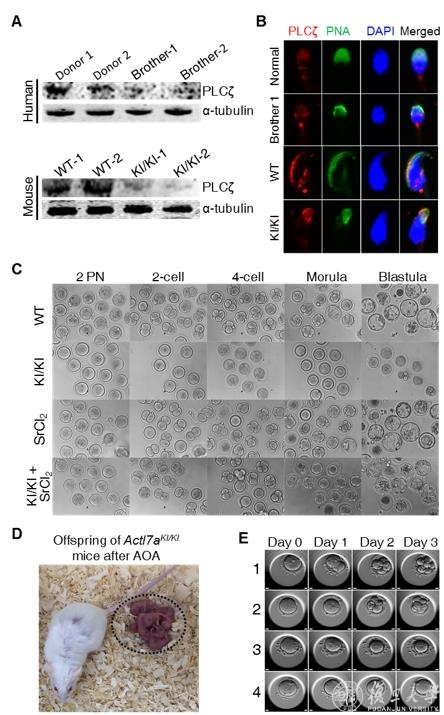
The researchers stated that early embryonic arrest has long been a major challenge in assisted reproductive centers, and is generally attributed to female factors. This study is the first to identify male genetic factors and their underlying mechanisms causing early embryonic arrest, and to explore intervention strategies, providing a new direction for clinicians in the diagnosis and treatment of such patients.
Starting from clinical problems, this study identified a new pathogenic gene through basic research, elucidated its pathogenic mechanism, and further found an intervention strategy for the disease, serving as a typical case of translational medicine research.
It is reported that Professor Sun Xiaoxi, Professor Zhang Feng, and Researcher Shi Huijuan are the co-corresponding authors of this paper. Postdoctoral Fellow Xin Aijie from the Obstetrics and Gynecology Hospital of Fudan University/Shanghai Institute of Planned Parenthood Research, Director Chen Guowu, Dr. Qu Ronggui, and Postdoctoral Fellow Zhang Ling from the Obstetrics and Gynecology Hospital of Fudan University/Shanghai Ji'ai Genetics and Infertility Center are the co-first authors. The project was supported by the Shanghai Science and Technology Commission, Shanghai Health Commission, National Natural Science Foundation of China, Shanghai Key Clinical Medical Center, and the Shanghai Municipal Major Science and Technology Program "International Human Phenome Project (Phase I)", among other projects.
#ACTL7A #EarlyEmbryonicArrest #MaleInfertility #GeneticMutation #AcrosomalDefects #PLCζ #SOAF #AOA #ICSI #IVF #ART #TranslationalMedicine #ScienceAdvances


Comments