From Palliative Care to a New Lease of Life: A Pakistani Lymphoma Patient’s Journey Seeking Medical Treatment in China

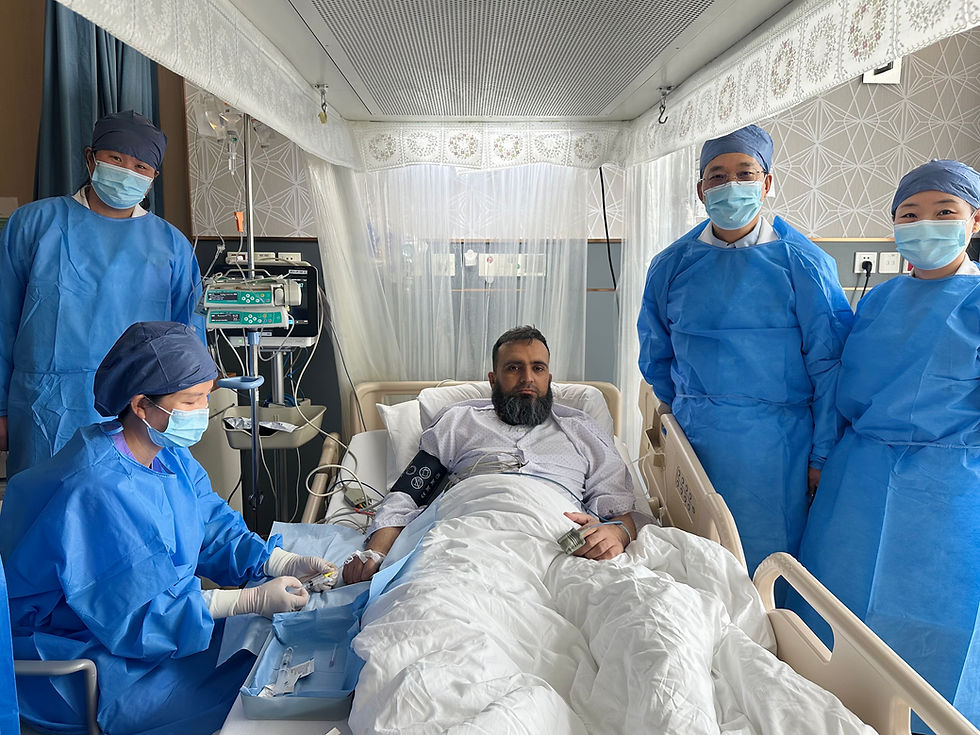
For 36-year-old Muhammad, good health had long been a distant dream over the past few years.
Hailing from Quetta, known as the "Fruit Garden" in southwestern Pakistan, Muhammad worked as a logistics staff member at a local public hospital. In 2021, a diagnosis completely changed his life: he was confirmed to have Diffuse Large B-Cell Lymphoma (DLBCL), an aggressive hematologic malignancy. He endured multiple rounds of chemotherapy and unbearable pain in the following days.
In 2024, Muhammad received a bone marrow transplant at Aga Khan Hospital in Pakistan, pinning all his hopes on the surgery, believing he could gradually return to a normal, healthy life. Yet fate dealt him a cruel blow: the cancer relapsed just 20 days after the procedure.
It was not only a physical setback but also a total collapse of hope. Back in Pakistan, the only remaining option for him was palliative care — a treatment focusing solely on relieving cancer pain instead of curing the disease. His attending doctor told him frankly: "We can do no more for you. You need to seek treatment abroad. We can provide a referral letter, but you will have to find a suitable hospital on your own."
After obtaining official approval from the Pakistan Medical Commission, Muhammad embarked on an overseas medical journey with a glimmer of hope for survival.
A Ray of Hope in Desperation: Traveling Across Oceans to Choose Jiahui
China was one of the recommended destinations, along with many others. Muhammad reached out to medical institutions across the globe, including Germany, Singapore, Austria, India, the United States and Australia. Each inquiry email he sent was like an SOS message in a bottle, with no idea when or who would reply.
"Hospitals in Germany responded very slowly, while treatment plans from Singapore and India were unclear," he recalled. "But one hospital got back to me promptly, communicated efficiently and even offered initial treatment advice — that was Shanghai Jiahui International Hospital." Eager to receive treatment, Muhammad made his decision without hesitation based on this positive first impression.
In early 2026, the exhausted and pain-stricken 36-year-old arrived in Shanghai accompanied by his family.
Receiving CAR-T Therapy at Jiahui
Follow-up examinations upon admission revealed his critical condition. He was diagnosed with Stage 4B lymphoma, with cancer cells having spread to his lungs, pleura and bones. The early relapse just 20 days after bone marrow transplant classified his case as relapsed and refractory lymphoma, which no longer responded to conventional therapies. Large tumors compressed his lungs and bones, causing severe pain that robbed him of sleep. He could only get temporary relief with high-dose and multiple potent analgesics. He also suffered from persistent high fever, night sweats and drastic weight loss.
Fortunately, Muhammad came to a country that is a global leader in CAR-T therapy. According to the latest analysis published in the academic journal Frontiers in Pharmacology, China has taken the lead worldwide in CAR-T research since 2016. By October 2025, China had the largest number of CAR-T clinical trials across the globe, and the number of domestically approved CAR-T products ranks second only to the United States. Studies have proven that China’s independently developed CAR-T therapies have achieved world-class clinical outcomes for hematological malignancies. Since 2021, four homegrown CAR-T products have been approved in China for the treatment of lymphoma and myeloma, meeting international efficacy standards.
In early April, Muhammad started a multi-week course of CAR-T therapy at Jiahui International Cancer Center. The full treatment process included autologous T-cell collection, bridging therapy to control tumor progression, lymphodepleting chemotherapy, and the final infusion of CAR-T cells.
In early May, preliminary PET-CT scans showed encouraging results: lymph node lesions shrank, and lactate dehydrogenase (LDH), a key tumor marker, returned to normal. Beyond improved test indicators, Muhammad’s excruciating pain was greatly alleviated. Upon admission, he relied on high-dose painkillers and sedatives to manage his symptoms. When discharged, he only needed two to three low-dose oral painkillers every 12 hours, with no breakthrough pain occurring.

As his visa was due to expire soon, the oncology team formulated a one-year follow-up plan and medication guidelines for him, to ensure he could monitor his condition and take medicine properly after returning to Pakistan.

Communication Beyond Language, Care Across Cultures
Physical pain was only part of his ordeal; the bigger challenge lay in language barriers.
Muhammad’s mother tongue is Urdu, a less widely spoken language, and his English proficiency was limited, though English was the only medium for doctor-patient communication. A large number of professional medical terms added to his confusion, and he struggled to accurately describe subtle physical discomforts.
"Language was the biggest obstacle," recalled Dr. Dong Yan, his attending physician. "Often, he could not understand what we explained, leading to huge information gaps."
However, the Jiahui medical team never let language hinder treatment. They used translation tools to convert all key information into Urdu. When translation software fell short, they resorted to simple gestures, eye contact and repeated confirmation. All medical advice, treatment plans and precautions were compiled into written documents, so Muhammad could translate and check them by himself.
Apart from communication, dietary arrangements required extra attention out of respect for his religious beliefs. Muhammad requested dry-cooked halal meals with good taste upon admission. The hospital catering team specially prepared customized halal food for him.
Muhammad maintained a good appetite during hospitalization and ate six eggs every day, which greatly boosted his recovery.

Farewell and Homeward Journey
On May 8, Muhammad boarded the flight back to Pakistan.
Though his overseas medical journey was far from smooth, he felt deeply relieved by the remarkable treatment effects and significant pain relief. What touched him most were countless moments of kindness, understanding and encouragement: every warm smile, every carefully prepared halal meal, every patient round of confirmation via translation tools, and every sincere gesture beyond words. These simple yet genuine connections bridged the language gap.
These precious moments of care also became part of his healing process.
"I will follow the follow-up plan and recuperate as instructed by the doctors at Jiahui after returning home. I hope to get fully recovered and go back to work soon. Inshallah."


Comments